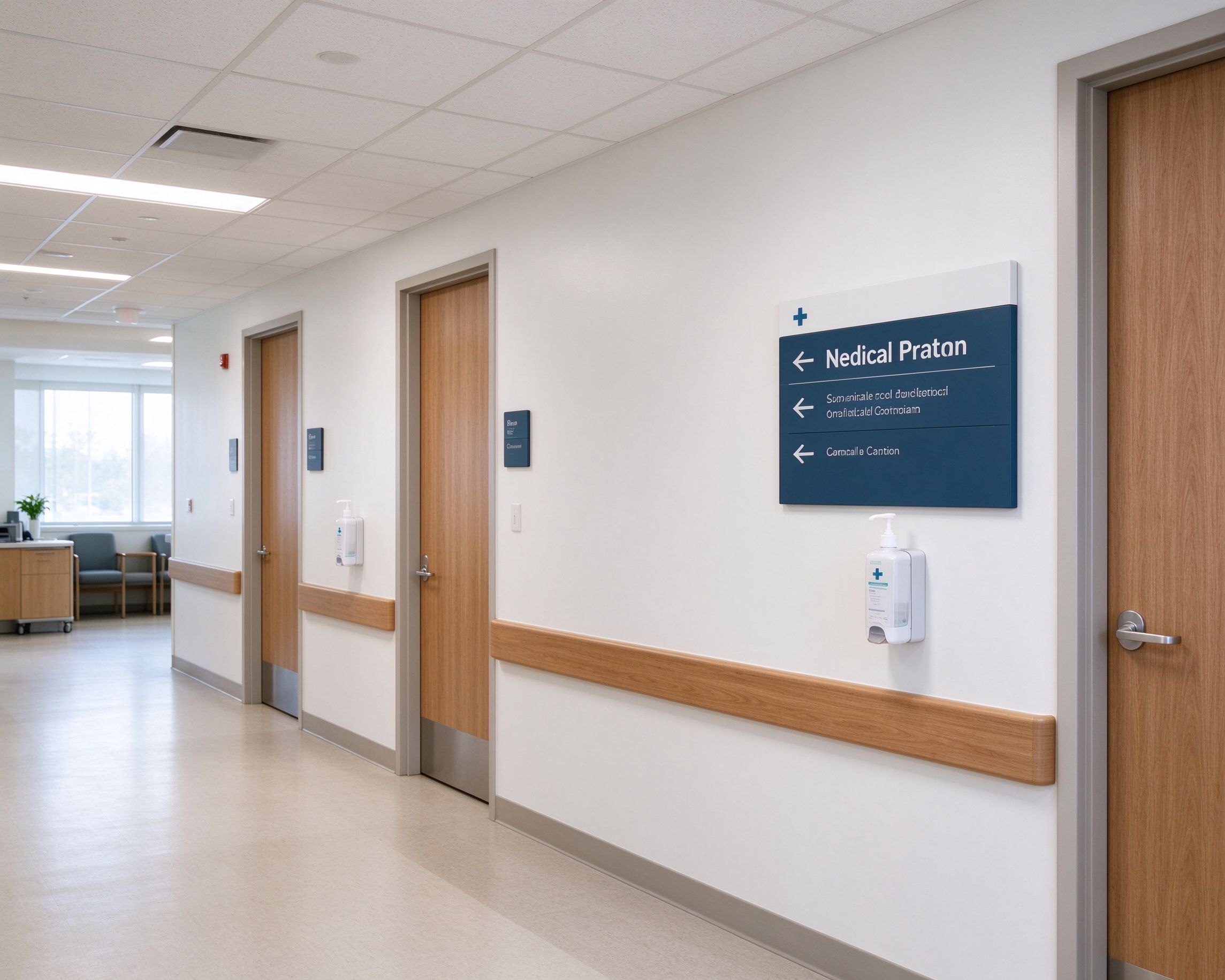
A parking and transit area is where good signage meets real consequences. Get it wrong and traffic backs up, drivers circle, pedestrians step into conflict with vehicles, and a commercial destination starts to feel unsafe before a visitor has even parked. Traffic facilities and line marking are the quiet systems that keep that chaos in order, and this project walkthrough follows how a transit-adjacent commercial parking area was planned and built using the same one-stop process our team applies from consultation to installation.
Parking guidance signs that actually guide
The purpose of a parking guidance signs program is not to decorate a wall; it is to answer a question the driver is asking at that exact moment: where do I enter, where do I pay, where is the exit, which level has space. We start by mapping the paths vehicles and people take, then place signs at the decision points rather than evenly along the wall. A sign that arrives after the turn is useless; a sign placed before it is gold.
For this project, overhead directional signs handled lane choice at the entry, while wall-mounted bay signs and level identifiers kept orientation once drivers were inside. Color coding by zone made the system legible at a glance, and the same palette was carried into the painted lines so that the floor and the signs spoke the same language.
Bollards: protection that also communicates
Bollards are often treated as pure hardware, but in a transit environment they do double duty. They physically protect pedestrians, storefronts, and equipment from vehicle impact, and they visually slow traffic by marking where vehicles should not go. We specified fixed and removable bollards at the right spacing to stop a wayward vehicle while still letting deliveries and maintenance through when needed.
Finish matters here. Bollards take constant knocks and weather, so powder-coated steel with reflective bands was used, giving both durability and night-time visibility. A bollard you cannot see in the dark is a bollard that will eventually be hit.
Directional paint and a coherent floor plan
Paint is the cheapest signage in the building and the most ignored, which is a mistake. Directional paint sets the rules before anyone reads a sign: lane direction, pedestrian crossings, loading zones, and no-parking stripes all live on the floor. We laid out the line marking to lead vehicles in a single logical loop, removing the ambiguous spaces where two drivers guess opposite things.
Arrows, stall lines, and hazard markings were drawn to a consistent width and color standard so the whole deck read as one system. Where the paint met a sign or a bollard, the message agreed, because a painted arrow that contradicts an overhead sign destroys trust in both.
Reflectivity and compliance in a working lot
A transit parking area runs at night, in rain, and under headlights, which is why reflectivity is non-negotiable. Line markings and signs used retroreflective materials rated for the environment, so they pop back at a driver’s headlights instead of disappearing into the dark. The same logic applied to edge lines, stair nosings, and the painted hazard zones near pedestrian routes.
Compliance is the frame around all of it. Local access requirements, accessible bay proportions, fire lanes, and exit clearances were built into the layout from the first survey rather than retrofitted after inspection. Designing for compliance early is cheaper than re-striping a finished deck, and it keeps the operator out of trouble with auditors and insurers alike.
Designing the lot as one connected system
The mistake most parking areas make is buying signs, paint, and bollards from three different suppliers and hoping they agree. They rarely do. A traffic facilities and line marking project works best when the floor, the walls, and the hardware are designed as one system from the first survey. The arrow on the ground should point where the overhead sign sends you, and the bollard line should reinforce the painted walkway rather than contradict it. Designing them together is what makes a lot feel calm instead of conflicting.
Coherence also helps maintenance. When one partner specifies the materials, a facilities team knows exactly what cleaner to use and what spare faces to stock. When three vendors each picked a different substrate, every repair becomes a small investigation. A single visual and material language keeps the lot readable to drivers and manageable for the people who look after it.
From survey to installed signs
The work began on site, measuring bay sizes, sightlines, and the routes vehicles and pedestrians actually take, because a layout drawn from a generic plan almost always misses the one conflict that matters. From that survey the concept was set, then detailed drawings fixed the exact placement of every sign, the spacing of every bollard, and the width and color of every painted line. Fabrication and painting followed the drawings, and installation was sequenced so the lot could stay partly operational while the new system went in.
Keeping the survey, design, fabrication, and installation under one partner meant a change discovered during install, such as a sightline blocked by a new planter, could be resolved on the spot rather than escalated through a chain of vendors. That responsiveness is what protects both the opening date and the quality of the finished result.
What the package covered
| Element | Role in the project | Why it mattered |
|---|---|---|
| Parking guidance signs | Overhead and wall direction | Answered the driver’s question before the turn |
| Bollards | Impact protection and pacing | Separated vehicles from people and assets |
| Directional paint | Floor rules and flow | Set behavior before any sign was read |
| Reflective materials | Night and wet-weather visibility | Kept messages visible under headlights |
| Compliance layout | Accessible bays, fire lanes, exits | Avoided costly rework and passed inspection |
Frequently asked questions
What are parking guidance signs used for?
They answer the questions a driver has at each decision point: where to enter, which level to use, where to pay, and how to exit. Placed before the turn rather than after it, they keep traffic moving and reduce circling.
Why use bollards in a transit parking area?
Bollards protect pedestrians, storefronts, and equipment from vehicle impact while visually slowing traffic. Reflective bands keep them visible at night, and removable types allow controlled access for deliveries.
How does directional paint improve flow?
Directional paint sets the rules on the floor: lane direction, crossings, and zones. A single logical loop with consistent arrows removes the ambiguous spaces where drivers guess opposite things.
Why is reflectivity important for line marking?
A lot runs at night and in rain. Retroreflective paint and signs return light to a driver’s headlights, so markings stay visible when they matter most, rather than fading into the dark.
How is compliance handled on these projects?
Accessible bays, fire lanes, and exit clearances are designed in from the first survey. Building compliance early avoids re-striping after inspection and keeps the operator aligned with auditors.
Can one supplier deliver the whole traffic package?
Yes. Our one-stop scope carries consultation, concept design, detailed design, fabrication, and delivery and installation together, so signs, paint, and bollards stay consistent and the operator deals with one partner.
Plan your traffic facilities with us
A parking and transit area is judged by how calm it feels under pressure, and that calm is engineered, not accidental. From parking guidance signs and bollards to reflective directional paint and a compliant layout, the system has to agree with itself at every turn. Our team designs, fabricates, and installs traffic facilities and line marking from a 5,000-plus square meter Guangzhou facility, with export experience across more than 30 countries. You can review our solutions and capabilities, see related work in our case studies, or read how our wayfinding projects are delivered. When you are ready, request a quote or contact us to start a consultation.







