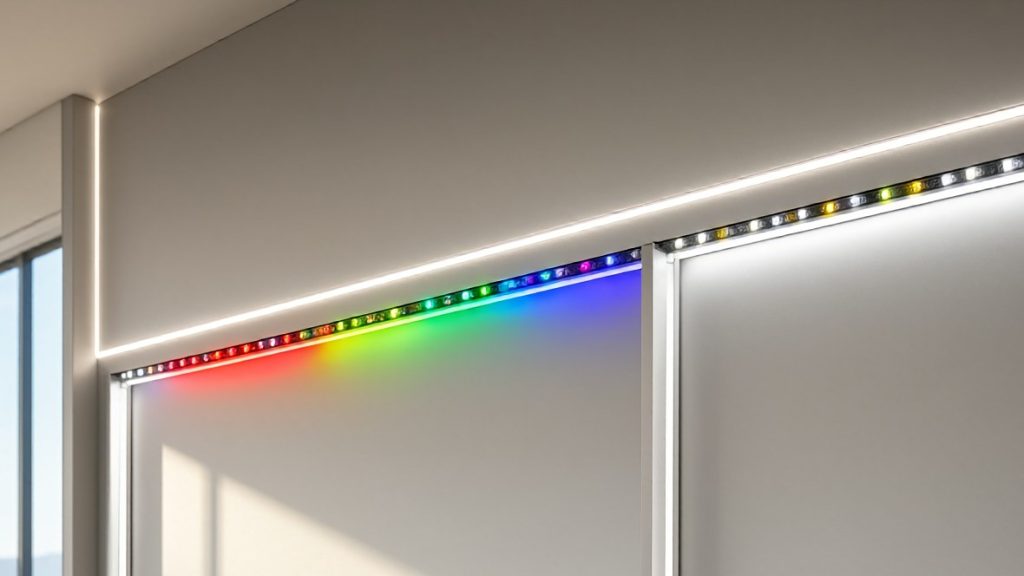
Buyers comparing RGB vs RGBW LED strips are usually trying to solve two different problems at once: how to make a sign change colour, and how to make the white in that sign look convincing. The two systems share a family resemblance, but they are built for different outcomes. RGB vs RGBW LED strips differ in whether a dedicated white emitter sits alongside the red, green and blue dies, and that small addition changes how colours are mixed, perceived brightness and the way a control system is programmed. Understanding the distinction before a specification is written avoids a common source of disappointment after installation.
Colour-changing signage has become a normal part of retail, hospitality and event environments, and the control choices have multiplied alongside it. General industry practice separates the question of colour generation from the question of control protocol: a strip can be RGB or RGBW, and it can be controlled as a whole zone or pixel by pixel. Those are independent decisions, although they are often conflated in product descriptions. This article describes the general behaviour of these systems rather than the performance of any particular product, and it assumes normal manufacturer guidance is followed during installation.
RGB vs RGBW LED strips: what actually changes
An RGB strip uses red, green and blue emitters in each LED package or along the strip, and a controller blends their output to produce a colour. In theory, combining the three at full output produces white. In practice, that white is a mixture of three narrow bands and often reads slightly blue or uneven compared with a purpose-built white emitter. An RGBW strip adds a fourth, dedicated white die, so the fixture can produce white directly rather than synthesising it. RGB vs RGBW LED strips therefore differ most visibly when the design calls for clean white light as well as colour.
The extra channel has consequences beyond colour. Because white is produced by a dedicated emitter, an RGBW strip can deliver a more convincing neutral white without running the coloured dies at full power. That can matter on a sign where white text or a white halo is part of the brand identity. The trade-off is a more complex strip, a driver and controller that support the fourth channel, and a slightly different physical footprint. The table below sets out the general distinctions; exact performance depends on the components and the way the strip is installed.
| Aspect | RGB | RGBW |
|---|---|---|
| White output | Synthesised from three colours | Dedicated white emitter |
| Colour saturation | Strong, controllable hues | Similar hues with true white available |
| Control complexity | Three channels per zone | Four channels per zone |
| Typical use | Colour wash and dynamic effects | Signs needing clean white and colour |
White channel and colour mixing
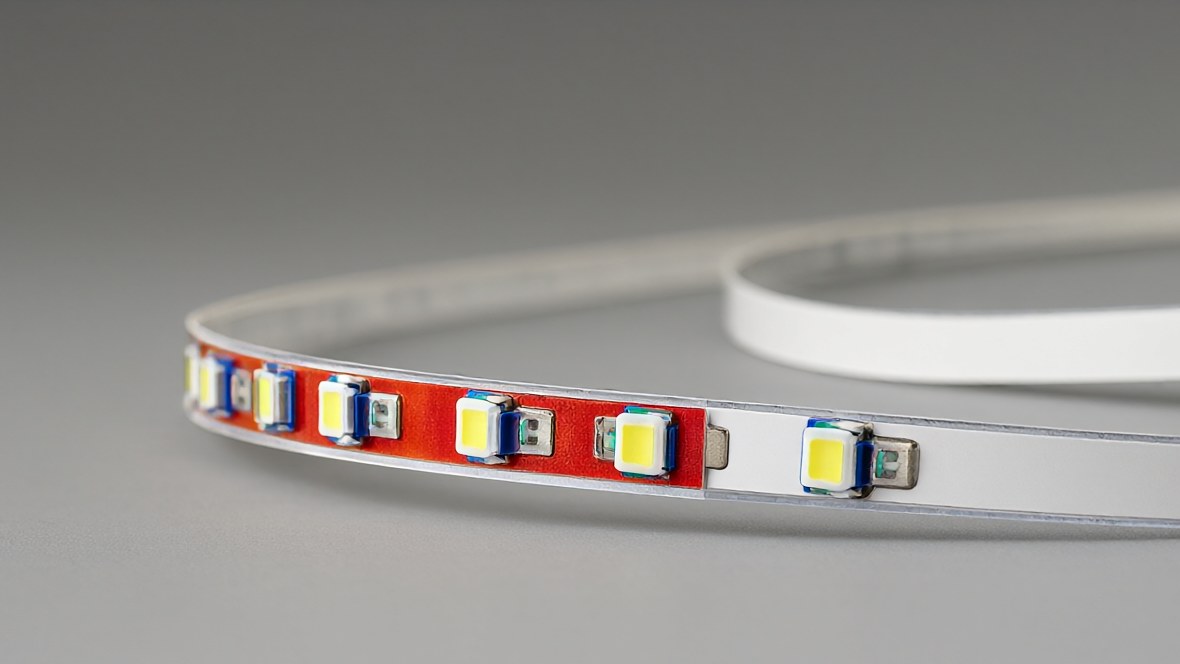
The white channel on an RGBW strip is what makes a neutral white possible without relying on colour mixing. When a controller is asked for white, it can drive the dedicated emitter instead of balancing three coloured ones. That is usually simpler to specify and more consistent across a batch, because the white emitter has its own output characteristics. Colour mixing still matters for the coloured hues, where the quality of the result depends on how finely the controller can adjust each channel and how well the emitters are matched along the strip. A poor match shows up as a gradual tint shift from one end of a run to the other.
A practical caution is that not all fourth channels are the same. Some strips offer a single warm or neutral white, while others provide a choice of white temperatures. A specifier should confirm which white is supplied and whether it suits the surrounding interior, since a white setting that is too warm can make a colour-changing sign look inconsistent with fixed lighting nearby. Keeping the same nominal white across an installation is generally less distracting than mixing several whites in one space. Where a brand specifies a particular white point, that requirement should be written into the lighting schedule rather than assumed from the word white.
Colour accuracy is a separate consideration from the number of channels. A strip can offer four outputs and still render nearby materials poorly if the emitters have weak colour rendering characteristics. For a sign that sits close to a branded surface, it is worth asking how the white emitter behaves against that material and whether a sample can be viewed before approval. This check is particularly useful when a design relies on a clean white halo around lettering, since the surrounding surface will reflect whatever tint the source produces.
RGBIC LED strip and addressable lighting
An RGBIC LED strip adds a control chip along the strip so that individual sections can be addressed independently. This is the basis of addressable lighting, where a controller sends a signal down the line and each segment responds to its assigned instruction. The result is the ability to create moving patterns, gradients and chasing effects that a standard RGB or RGBW zone cannot produce. For signs that rely on animation rather than a single changing colour, addressable lighting opens a wider design vocabulary and makes it possible to guide a viewer’s eye across a façade.
That flexibility comes with system requirements. An RGBIC LED strip needs a controller that understands the relevant protocol, correct signal wiring and attention to the number of pixels that can be driven from one output. Long runs may need signal amplification or power injection at intervals, and poor connections show up as flicker or colour breaks. It is also worth remembering that addressability is a control feature, not a colour-generation method: an RGBIC strip may be RGB or RGBW underneath, and the two choices should be specified separately. Asking which protocol is used prevents a controller being ordered that cannot drive the strip.
Signage colour control for RGB vs RGBW LED strips
Signage colour control brings the electrical and the creative together. For a simple sign that shifts between a small set of brand colours, a basic controller with stored scenes may be enough. For a façade or interior scheme that changes with time of day or responds to an event, a programmable system with addressable outputs gives more room. The decision should be driven by how often the colours change, who will operate the system and how much consistency matters across repeated installations. A system that is too complex for the person running it will end up stuck on one scene.
Whichever system is chosen, documentation is part of the deliverable. The colour values, scene list, channel mapping and controller settings should be recorded at handover so a replacement controller can be configured without repeating the design work. This is particularly useful for multi-site rollouts, where a sign in one location must look the same as its counterpart elsewhere. Good signage colour control is less about the number of available colours and more about being able to reproduce the intended ones reliably over the life of the installation.

Questions buyers often ask
How do I decide between RGB vs RGBW LED strips?
If the design needs clean white as well as colour, RGBW is usually the more straightforward choice because it has a dedicated emitter. RGB vs RGBW LED strips both produce colour, so the decision often turns on how important a neutral white is to the brand and how much complexity the control system can accommodate. A short sample viewed on site is the most reliable test.
Can RGB strips produce white?
They can approximate white by mixing red, green and blue, but the result is a blend of three bands rather than the output of a white emitter. It may look tinted beside fixed white lighting. Where a sign depends on an exact white, a dedicated white channel is generally easier to specify and verify under the conditions where the sign will be seen.
What does the white channel change?
It adds a fourth controllable output. That changes wiring, controller programming and sometimes the physical profile of the strip. It also gives the designer a direct way to produce white without relying on colour mixing, which tends to be more consistent along a run. Confirm the white temperature before ordering, since the term alone is not specific.
Is an RGBIC LED strip the same as RGBW?
No. RGBIC refers to individual addressability through an onboard chip, while RGBW refers to the presence of a white emitter. The two describe different features and can be combined. A buyer should ask about both when a design needs moving effects and clean white, because a product name rarely makes the distinction clear.
How does addressable lighting affect wiring?
An addressable system needs a controller that matches the strip’s protocol, careful signal connections and, on longer runs, power injection at planned points. Faulty data connections usually appear as flicker or broken colour patterns rather than a complete failure, so commissioning should include a full visual check across every segment of the sign.
What should signage colour control include at handover?
Record the scene list, colour values, channel mapping and controller settings alongside the electrical drawing. Control that is documented can be reproduced after a controller failure or at a second site. Without that record, restoring the original look becomes a matter of trial and error, and the sign may look different from its counterparts.
Colour system and control method are separate decisions, and both deserve a place in the specification. To explore illuminated options, review our product range and capabilities, send a brief through the quote form, or check the FAQ for common questions.







