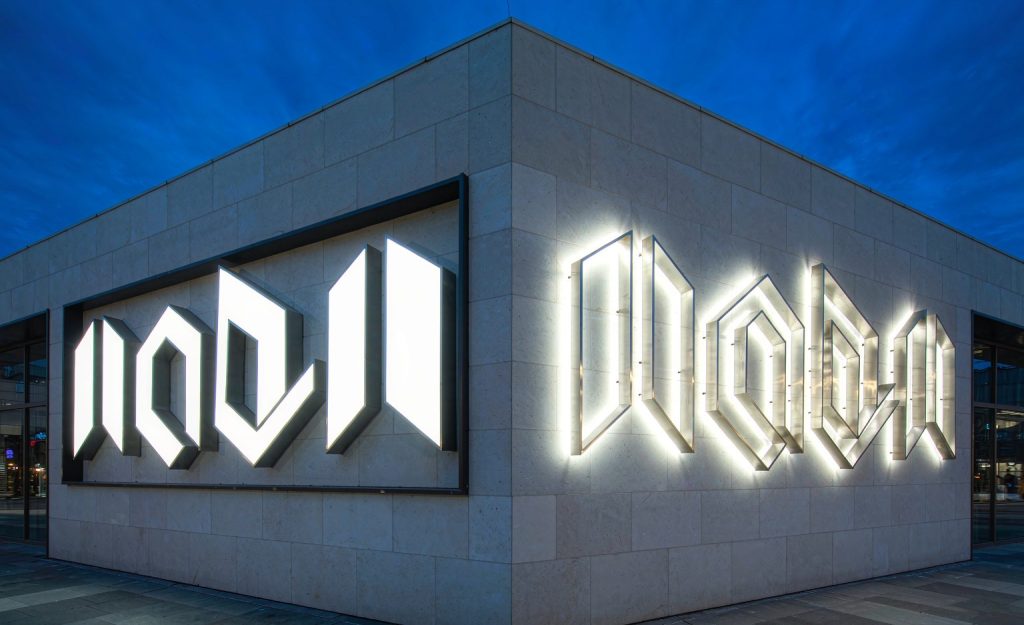
Choosing between frontlit vs backlit channel letters is usually the first decision that stalls a signage RFQ. Both systems use fabricated metal letters and low-voltage LED modules, both can be built to the same brand guidelines, and both can look excellent on a finished facade. They simply solve different optical problems. Front-lit letters push light forward through an acrylic face for maximum legibility at distance. Halo-lit, or back-lit, letters wash light onto the wall behind them for a quieter, more architectural effect. Getting the call wrong is expensive, because the mounting depth, wall finish, driver position, brightness testing and even the packing list all change with it.
This guide explains how each construction works, what the LED specification actually involves, and how to write a brief that gets you a comparable price. It is written from the questions we ask on real export projects at our Guangzhou factory, not from a catalogue. If you already have drawings, our quotation page is the fastest route to a project-specific recommendation.
Frontlit vs Backlit Channel Letters: The Short Answer
If you need one rule, use this: choose front-lit when the sign has to be read, and choose back-lit when the sign has to be felt. Front-lit letters are legible from a road, a car park or the far end of a mall. Back-lit letters create a premium outline that rewards a closer view, which is why they dominate hotel entrances, corporate lobbies and flagship retail.
| Decision factor | Front-lit (face-lit) letters | Back-lit (halo / reverse) letters |
|---|---|---|
| Light direction | Forward, through a translucent acrylic face | Backward, reflected off the mounting wall |
| Long-distance legibility | High; the face itself is the light source | Moderate; the letter face stays dark |
| Daytime appearance | Brand colour visible via acrylic face or vinyl | Metal finish only (brushed, anodised, PVD) |
| Wall dependency | Low; works on most facades | High; needs a smooth, light, matte surface |
| Night character | Bright, direct, high contrast | Soft halo, low glare, restrained |
| Typical setting | Retail storefronts, fuel forecourts, shopping centres | Hotels, offices, galleries, premium flagships |
| Relative complexity | Face and diffuser uniformity is the challenge | Standoff distance and wall reflectance are the challenge |
Neither option is automatically more expensive or more “premium”. The cost driver is usually the letter count, return depth, finish, access equipment and the amount of electrical testing required for the destination market — not the direction the LEDs happen to point.
What Frontlit Channel Letters Are Made Of
Frontlit channel letters are essentially small light boxes shaped like letters: a fabricated metal return forms the sides, a translucent acrylic face closes the front, and a backing plate closes the rear. LED modules sit inside the cavity and point forward through the diffuser. Acrylic, 304 stainless steel, aluminium and tempered glass are the usual materials; matte, gloss, brushed, anodised and PVD titanium finishes are all workable, and a custom colour can be matched to a brand reference.
The detail that separates a good face-lit letter from a poor one is uniformity. Return depth, LED spacing, diffuser selection and face material all change how evenly the letter reads at night. We position modules to avoid hot spots behind narrow strokes, and for any new profile we build a single-letter mock-up and photograph it at the specified viewing distance before releasing the full order. That one step catches more problems than any amount of retouching in a product rendering.
The practical advantages are straightforward. Front-lit letters carry brand colour in daylight, stay readable in heavy rain or bright street lighting, and can be seen from the approach roads that matter for retail. They also tolerate difficult backdrops: dark cladding, glass curtain walls and uneven brickwork do not change how the sign performs, because the light never depends on the wall.
The limitations are mostly about glare and tone. A full-brightness acrylic face can look harsh on a quiet residential street or a heritage facade, and some municipalities limit luminous intensity after certain hours. On highly reflective glass, the face can double-image at night. Where a brand guideline calls for restraint, we often reduce output, dim by circuit, or propose an edge-lit acrylic alternative from the same illuminated letters range.
Backlit Letters, Halo Lit Letters and Reverse Channel Letters
These three terms describe the same family, and mixing them up is one of the most common causes of a mispriced inquiry. Reverse channel letters have a solid metal face and an open or translucent back, with the LEDs aimed backwards at the wall. Halo lit letters is the trade name for the glow that results. Backlit letters is the loosest term: some suppliers use it for a lightbox or a panel with a translucent backing, so always ask for a section drawing before comparing quotations.
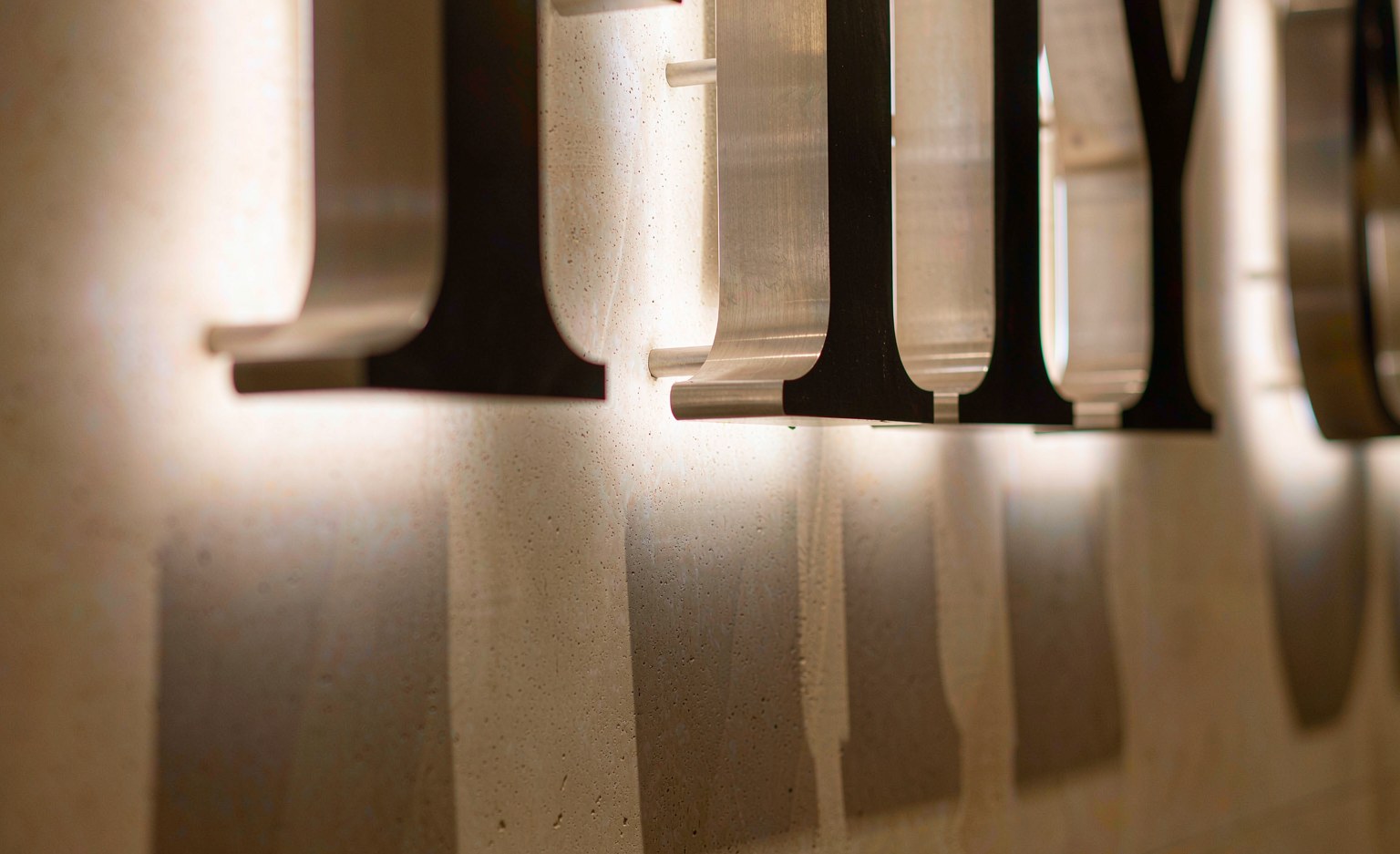
Because the halo is produced by reflection, the wall is part of the optical system rather than just a fixing surface. Standoff distance, wall colour and wall texture all change the result. A rough, dark or heavily jointed surface absorbs the wash and breaks the outline; a smooth, light-coloured stone or painted render gives the clean, even edge that most brand guidelines assume. If the facade is still being designed, this is the moment to specify it — a halo detail is far cheaper to coordinate on a drawing than to fix on a scaffold.
Backlit Building Signage Benefits Beyond the Halo
The best-known backlit building signage benefits are aesthetic, but the practical ones matter just as much on export projects. Because the illuminated area is indirect, there is less perceived glare for pedestrians and drivers, which helps in jurisdictions with light-spill or curfew rules. The metal face remains a solid, durable surface with no acrylic to yellow, craze or delaminate under UV. And because the lettering reads as a silhouette by day, a brushed or PVD titanium finish can carry the brand without any applied vinyl or printed colour at all.
There are trade-offs. A halo reads well at close and medium range but loses definition at the distances where face-lit letters still work. Dark cladding, ribbed metal and textured render are poor reflectors. And a halo sign needs a controlled night-time check on the actual wall: we recommend approving one letter on site, or at minimum on a sample panel in the specified finish, before the full set is released.
What LED Lighting Is Used Inside Illuminated Sign Letters?
Buyers regularly ask what LED lighting is used inside illuminated sign letters, usually because a previous supplier substituted modules and the colour shifted halfway through a facade. In practice the assembly is low-voltage LED modules on a constant-voltage driver, a diffuser or lens appropriate to the letter depth, sealed wiring, and a protected enclosure for mains connection. Colour temperature, binning and driver quality determine whether two letters produced six months apart still match.
For outdoor work, IP65-rated components, sealed joints, a ventilated driver compartment and UV-protected low-voltage cable are the baseline. We specify LED modules, drivers and wiring for the destination market, confirming supply voltage, frequency and plug standard before production. Every module is burned in before assembly and its batch recorded; the finished sign is tested for brightness, colour consistency and earth continuity. Where a project requires certificates for the electrical components, we confirm the exact model and documentation before the order is placed rather than promising a generic certificate after shipment. That distinction is worth insisting on with any supplier.
One more question worth asking: what happens in year four? A sign is a maintained asset. We include spare LED modules, a driver wiring diagram and a simple troubleshooting sheet, and can label each circuit and provide a cleaning and electrical-check schedule where a maintenance contract exists. A slightly better driver at specification stage is cheaper than a cherry picker later.
A Six-Question Framework Before You Specify
- How far away must it be read? Measure the real approach, not the plan drawing. Beyond roughly a hundred metres, front-lit usually wins.
- What is the wall made of? Send a photograph and the finish specification. If it is dark, glossy or heavily textured, a halo needs a mock-up or a different treatment.
- What do the brand guidelines require? If a precise daytime colour is mandatory, an acrylic face with a matched vinyl or a PVD finish is easier to control than reflected light.
- What do local lighting rules allow? Curfews, maximum luminance and light-spill limits can decide the question for you, particularly on mixed-use developments.
- How will it be serviced? Confirm driver location, access and whether the facade owner allows a maintenance circuit to be isolated.
- What is on the critical path? Our lead time is 10–25 working days depending on scope and specifications, with a 2–5 year official warranty and lifetime structural technical support. Design approval, mock-ups and shipping add time, so work backwards from the opening date.
If you are still weighing this against a cabinet or lightbox solution, that is a separate comparison — our architectural signage solutions overview sets out where each system belongs, and our fabrication capabilities page documents the engineering and testing behind them.
Five Mistakes We See in RFQs
- Size without context. “600 mm letters, quantity 12” is not enough. We also need the fixing condition (wall, floor, ceiling or steel structure), the viewing distance and a wall sample.
- Using “backlit” without a drawing. State explicitly whether you mean reverse channel letters, an edge-lit acrylic letter or a lightbox.
- Leaving electrical details to later. Voltage, frequency and plug standard belong in the first quote, not a change order after production.
- Skipping the single-letter mock-up. Uniformity and halo spread cannot be judged from a flat rendering.
- Forgetting the destination. The project address or port affects packaging, documentation and component certification, so include it with the quotation request.
From CAD to Crate: How Either Option Ships
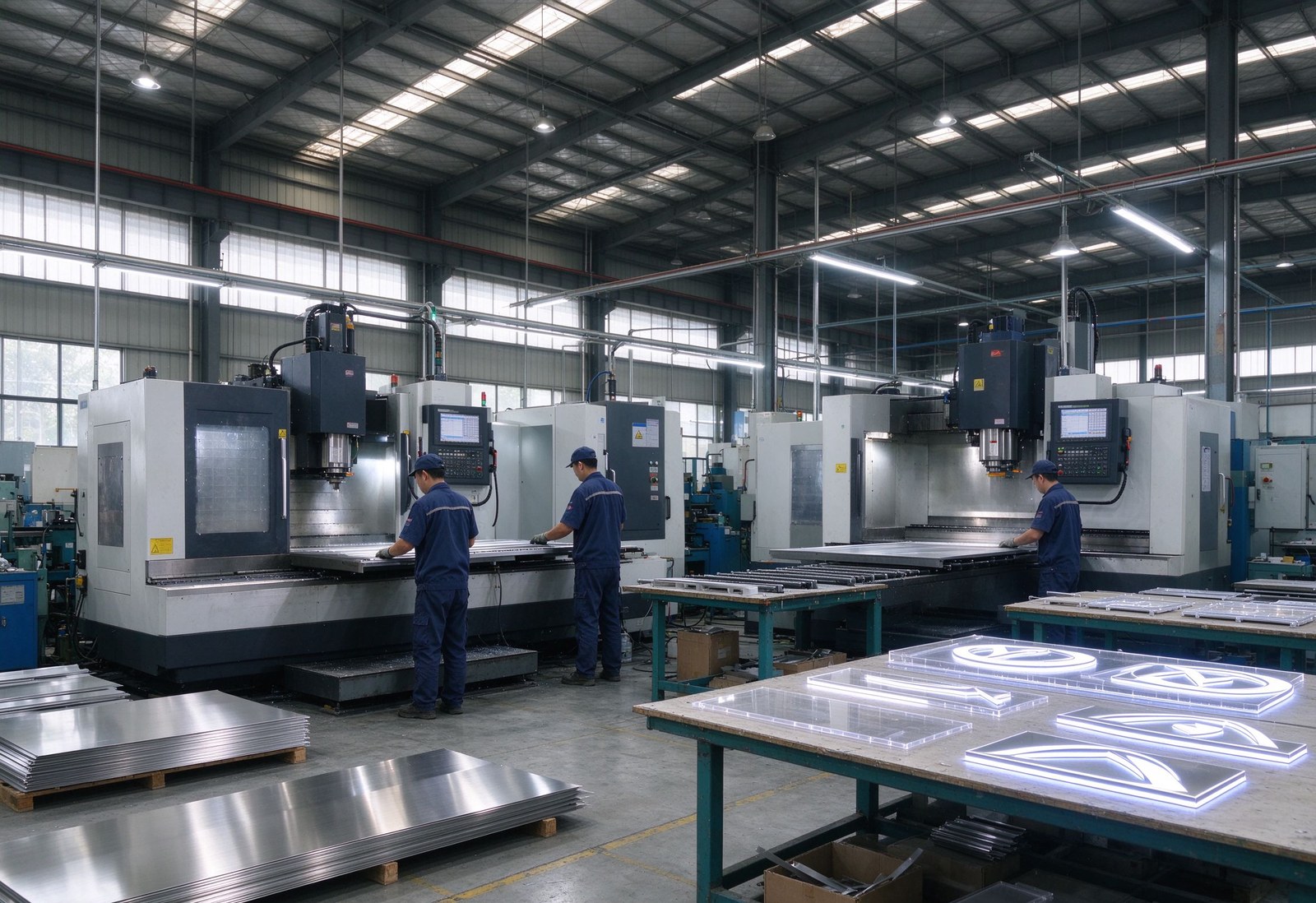
Once the illumination method is fixed, both variants follow the same production path: full CAD engineering and structural calculation, shop drawings for approval, fabrication, electrical assembly, burn-in and testing, then export packing. Letters are supplied with a mounting template, fixing bolts and a paper or acrylic pattern that matches the approved artwork. The template marks the baseline, centres and cable entry points, which removes most installation errors when a crew is working on a scaffold.
Long spans are split into transportable sections with concealed joints. Each section is packed in a foam-lined plywood crate with a removable protective film over the face, using fumigated export packaging. Complete CAD assembly drawings and remote assembly guidance are included. It is unglamorous work, but it is the part that determines whether a sign arrives as a sign rather than a set of expensive spare parts. You can see the same process described in our factory article and in the project case studies.
Frequently Asked Questions
Are backlit letters readable from a long distance?
Less so than face-lit letters. The dark metal face reads by contrast against a glowing outline, which is elegant up close but loses definition with distance and competing light. For roadside or car-park visibility, frontlit channel letters are the safer specification.
Can one sign combine front-lit and halo-lit letters?
Yes. Combination or front-and-back-lit letters are common where a wordmark needs both daytime colour and a soft night halo. They need a deeper return, separate circuits and careful brightness balancing, so ask for a section drawing and a mock-up.
Do halo lit letters work on dark or textured walls?
Poorly. Dark surfaces absorb the wash and rough surfaces scatter it. A light, smooth, matte wall gives the cleanest halo. Where the facade cannot be changed, we would normally recommend face-lit or edge-lit letters instead.
What LED lighting is used inside illuminated sign letters, and can it be replaced?
Low-voltage LED modules on a driver, specified for the destination market and burned in before assembly. We supply spare modules and a driver wiring diagram so a failed circuit can be repaired without remaking the letter.
What is the typical lead time and warranty?
10–25 working days depending on scope and specifications, with a 2–5 year official warranty and lifetime structural technical support. Samples, approval drawings and freight are quoted separately.
What should I send to get an accurate quote?
Overall sizes, quantities by type, the finish or colour reference, whether illumination is needed, the fixing condition and the project address or port. A drawing, sign schedule and destination is ideal; if the drawings are not final, a marked-up PDF or a measured sketch is enough to start. We return a list of assumptions, a shop-drawing request and an itemised quotation so that comparisons are based on the same scope.
Get a Written Recommendation for Your Project
The frontlit vs backlit channel letters decision is really a decision about viewing distance, facade material and brand tone — and it is much easier to make with a section drawing in front of you than with a mood board. Send us the wall finish, the approach distance and the drawings, and we will come back with a written recommendation, an itemised quotation and, where a new finish or profile is involved, a sample before the full order.
Request a quotation or contact our team directly. Our signage FAQ covers MOQ, samples, colour matching and export packing, and about our factory gives the background on how we build and ship these systems.







