Selling a sign locally is one thing; shipping a finished, fragile, often illuminated structure across an ocean is another. Exporting custom signage means the product has to survive transport, clear customs, and still arrive looking exactly like the approved drawing. Our work export custom signage worldwide to more than 30 countries, and the process is built around removing the friction that normally makes international signage risky.
Trade terms that fit the buyer
International orders start with how responsibility is split between seller and buyer. We work with standard terms including DDP, FOB, and EXW, so a client can choose the level of control and risk they are comfortable with. DDP places more of the logistics and duty burden on us, delivering closer to the client’s door. FOB hands off at the port of shipment. EXW leaves collection to the buyer at our facility.
Offering these options matters because buyers differ. A first-time importer often prefers DDP to avoid navigating customs, while an experienced distributor may choose FOB or EXW to use their own freight forwarder. Matching the term to the buyer keeps the relationship smooth from the first quote.
Export packing built for the journey
Signs are unforgiving in transit. Glass faces, thin returns, and finished surfaces can be ruined by a single rough handling moment. Export packing is therefore engineered, not improvised: foam protection at edges, rigid crating for large or heavy pieces, moisture control for sea freight, and clear labeling so handlers know which way is up. Lit assemblies are packed so modules and connectors are protected and easy to locate on arrival.
Good packing also speeds unpacking and install. When components are labeled and organized to the shop drawings, the on-site team assembles faster and with fewer errors, which protects the lead time promised at order.
Lead time you can plan around
International projects live on schedules, and a missed ship date cascades into a delayed opening. Our standard lead time 10-25 working days covers fabrication after design approval, with the exact window depending on scope, finish, and volume. That range is communicated early so buyers can book freight and site crews with confidence rather than hope.
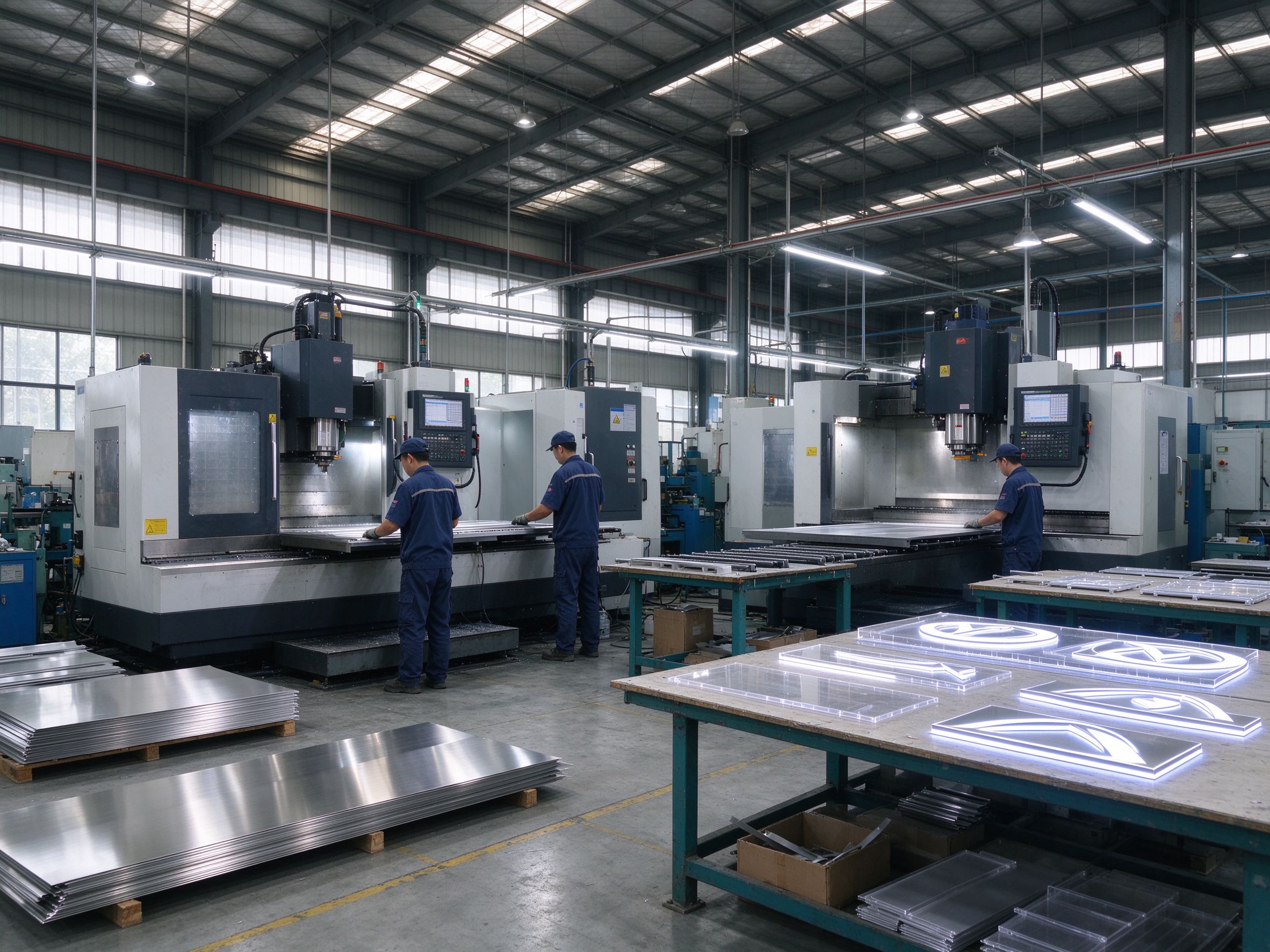
Lead time is protected by keeping fabrication in-house. When cutting, bending, finishing, and testing happen in our own Guangzhou facility, a late change or a quality catch does not require renegotiating with an external shop, which is what keeps delivery dates realistic.
Certifications that clear markets
Different regions expect different evidence that a product is safe and built to standard. Our products are built to CE, UL, and ISO expectations, covering European, North American, and quality-management requirements respectively. For an exporter, these are not paperwork; they are what lets a sign pass inspection and satisfy an end client’s spec sheet in markets we may never visit.
ISO 9001 quality management underpins the process side, meaning the build is documented and repeatable. That repeatability is exactly what a buyer with multiple sites wants, because the second order should match the first.
Global shipping coordination
Global shipping ties the pieces together: choosing the right mode, consolidating where it saves cost, preparing documents, and tracking to arrival. Because we ship to more than 30 countries, the logistics patterns, from documentation to pallet standards, are routine rather than a one-off scramble. That experience is what lets an overseas buyer treat a Guangzhou order like a local one.
Documentation that clears customs
A sign can be perfectly built and still stall at a border if the paperwork is wrong. Export documentation, from commercial invoices and packing lists to certificates that support CE, UL, and ISO claims, is treated as part of the deliverable rather than an afterthought. Getting it right before the crate leaves the factory is what keeps a shipment moving instead of sitting in a holding area accruing demurrage.
The certifications themselves do quiet heavy lifting. A product built to the right regional expectations arrives with the evidence a buyer’s own inspector or end client expects, which smooths acceptance on site. For repeat buyers with multiple locations, that documented, repeatable compliance is what lets a Guangzhou order clear as routinely as a domestic one.
Planning the order backward from opening
International projects are chained to a date: a store opening, a building handover, a campaign launch. We plan the order backward from that date, setting the fabrication window inside the 10 to 25 working day lead time and then booking freight and install around it. The moment transport is treated as separate from production is the moment the opening date starts to slip.
Choosing the right trade term supports this planning. A buyer comfortable with DDP gets a nearer-to-door delivery and less to coordinate; one using FOB or EXW keeps their own freight forwarder in the loop. Whichever is chosen, the plan is shared early so the buyer can schedule site crews and inspections with confidence, and the signage arrives in time to be mounted rather than rushed.
The export process at a glance
| Step | What we do | Buyer benefit |
|---|---|---|
| Trade terms | DDP, FOB, or EXW | Risk matched to buyer |
| Export packing | Crated, protected, labeled | Arrives intact and organized |
| Lead time | 10-25 working days | Plan freight and site with confidence |
| Certifications | CE, UL, ISO | Clears markets and specs |
| Global shipping | Coordinated logistics | Overseas order feels local |
Making an overseas order feel local
The goal of any export program is to remove the feeling of distance. When trade terms, packing, lead time, certifications, and shipping all line up, a buyer in another country experiences a Guangzhou order much like a domestic one: quoted clearly, packed safely, delivered on a known date, and cleared with the right documents. Our routine exports to more than 30 countries turn what looks complex into a managed process, which is why repeat buyers come back for second and third sites rather than looking for a new supplier each time.
Export is ultimately a promise about certainty: that the product will arrive, intact and compliant, on a date the buyer can plan around. Every part of the process, from trade term to packing to certification, exists to keep that promise believable for clients in more than 30 countries.
Frequently asked questions
Which trade terms do you offer for export?
We work with DDP, FOB, and EXW. DDP handles more of the logistics and duties, FOB hands off at the shipment port, and EXW leaves collection at our facility, so buyers pick the balance of control they prefer.
How is signage packed for export?
Export packing uses edge foam, rigid crating for large pieces, moisture control for sea freight, and clear labeling aligned to the shop drawings, so products arrive intact and easy to assemble.
What is the typical lead time?
After design approval, fabrication typically runs within a 10 to 25 working day lead time, depending on scope and finish. The window is shared early so freight and install can be scheduled reliably.
Are products certified for other markets?
Yes. Products are built to CE, UL, and ISO expectations, including ISO 9001 quality management, which supports clearance and spec compliance across more than 30 countries.
Do you handle global shipping directly?
We coordinate global shipping, from mode selection and consolidation to documentation and tracking, drawing on regular exports to many countries so the process is routine.
Can a multi-site buyer get consistent product?
Yes. In-house fabrication and documented ISO 9001 process mean repeat orders match the original, which is what buyers with several locations rely on.
Ship your signage with confidence
Exporting signage should feel like ordering locally, and with the right trade terms, packing, lead time, and certifications it can. Our team designs, fabricates, and ships custom signage from a 5,000-plus square meter Guangzhou facility to clients across more than 30 countries, built to CE, UL, and ISO expectations. You can review our solutions and capabilities, read our FAQ, or see how our Guangzhou factory supports export builds. When you are ready, request a quote or contact us to discuss your shipment.